I've just released the new edition of my book, Coasters 101: An Engineer’s Guide to Roller Coaster Design. If you purchased the Kindle version previously you get free updates. If you purchased the paperback version, you can get the latest digital version for free now too! The latest edition (third) has pictures, diagrams, new content, a better layout, and other general improvements. My goal is to make this book simply the best, most complete, most detailed guide to designing roller coasters you can find. A few of the most recent reviews tend to agree:
“Very impressive! What a great resource to have..for anyone.” - John S.
“Thanks for writing a very good book. I could not put it down. Lot's of great information. I am a technology and engineering teacher and the information I found here is very helpful in trying to get students more excited about engineering.” Amazon reviewer
Rotation about the track spine
Some of the questions about roller coaster design you will have answered after reading include:
What software do roller coaster engineers use?
What college major is best to become a coaster designer?
How many engineers does it take to design a coaster?
How do roller coasters reach their highest point?
Why don’t coaster cars roll backwards down the lift hill?
Why do wheels on steel coasters come in pairs?
Why do we see so many clones of the exact same ride built at multiple parks?
How does a 4D coaster work?
How much does a roller coaster cost?
How much time does it take to design a roller coaster?
What is the difference between LIM and LSM propulsion?
What sort of background is necessary to get into the roller coaster engineering field?
How do you calculate the amount of power needed for the lift hill?
Dollywood recently released the full layout of their new family roller coaster debuting in 2014, FireChaser Express. The layout includes a foward launch, a chain lift, and a backwards launch out of an exploding fireworks factory. Here's the complete ride animation:
The very cool and unique Adventure Mountain climbing structure and ropes course had to be partially removed but it looks like a lot of the towers are going to be reused in the theming for FireChaser. I've taken a overhead image of the site and drew the layout on it based on the renderings available and the POV video.
I think FireChaser Express looks like a fun little ride and and a great addition to Dollywood. Dare I say it might even be better than Wild Eagle (due to potentially more airtime)?! What say you?
Blueprints of the Kings Island 2014 roller coaster layout have made their way onto the internet a full week before the official announcement from the park. Spoiler alert: Kings Island has already started construction on their new B&M inverted coaster, likely named "Banshee." The roller coaster is being teased as a world-record breaker, meaning it will probably be the tallest, fastest, or longest inverted coaster and possibly even have eight inversions, the most in North America. The color scheme will most likely be blue and silver. Some of the Kings Island 2014 blueprints are pictured below. Banshee's layout looks something like this:
Lift hill threaded through the vertical loop
Right side curving drop
Dive loop
Vertical loop around the lift hill
Zero-g roll
Overbanked turn
Batwing element (2 inversions)
Vertical loop number two
Turnaround
Another barrel roll
Helix
Flatspin/corksrew into the final brakes
If you look closely at the blueprints you can see the footers of two defunct roller coasters: Son of Beast, where Banshee is being built, and the old stand-up coaster King Cobra. As an added bonus, here's an overhead picture of Adventure Express' layout.
Have you ever wanted to design your own roller coaster? Sure, many of us have. But I’m not talking about using a computer game like RollerCoaster Tycoon or NoLimits. I’m talking about using real roller coaster physics formulas and equations. I recently had the chance to interview a mechanical engineering college student and aspiring roller coaster engineer who has done just that! He has designed his very own GCI inspired wooden roller coaster using only a Microsoft Excel spreadsheet and MatLAB. Read all about this roller coaster design spreadsheet on my Excel Spreadsheets Help blog.
A new website has popped up called RollerCoaster Tycoon 4 release date. While there isn’t really a whole lot of new information, they do list out a timeline of known events and information about the upcoming roller coaster simulation game. They also promise to be the first website to post any updates on the RollerCoaster Tycoon 4 release date as soon as it becomes available, although I don’t expect to hear anything until after RCT3D hits the market.
What is RCT3D you ask? It’s the next installment of the Roller Coaster Tycoon series. However, this latest game is only available on the Nintendo 3DS handheld system. After being delayed several times, RollerCoaster Tycoon 3D is still set for a release date of August 28th (which you can pre-order here).
I also encourage you to sign up for the RCT newsletter to be the first to know about a new giveaway contest I will be hosting coming up soon with some prizes geared toward theme park nerds.
If you haven’t noticed, I added a link above to a new page on this blog called Ride Layouts. Here I plan on including links to all my posts where I’ve displayed ride layouts, blueprints, and diagrams, especially those classic Disney attractions.
Today, we look back on another classic attraction of Disney World's Magic Kingdom which is no longer with us. The Skyway was removed from the Magic Kingdom in 1999 after a maintenance worker was killed from falling off a gondola while working on the ride. One unique aspect of this particular ride was the fact that it wasn’t laid out in a straight line like the majority of other similar sky ride type transportation rides. Magic Kingdom’s Skyway had more of a L-shape with a bend in the middle.
Overview and Layout
The Disney Skyway was an aerial tramway providing a scenic overview of the park and stretched from Tomorrowland to Fantasyland in the center of Walt Disney World’s Magic Kingdom. Guests boarded at either end for a one-way trip to the opposite station, traveling in gondolas (cabins) suspended from a moving cable. Each cabin could accommodate up to four adult guests. For guests boarding at the Tension Station in Tomorrowland, the cabins traveled along the moving cable across the Grand Prix Raceway, came down at the Transfer Station and made a 116 degree left-hand turn, then climbed and crossed Fantasyland ending their journey at the Drive Station. The Skyway ride system consisted of 50 cabins, which traveled on 3600 feet of steel wire rope.
How it worked
Like all Disney theme park attractions, the ride was closely monitored and controlled by a Ride Control System (RCS). Emergency Stops were provided at each station, and the RCS could also stop the ride based on certain fault conditions. The Skyway actually was designed with an auxiliary backup diesel motor. This was only used to cycle out the ride if the main drive motor became inoperable. The motor powered a hydraulic pump which provided hydraulic pressure to one of two motors: one located at the gear box to be used if the main drive motor was inoperative, and a second one located upstairs at the bullwheel to be used if the gearbox was inoperative. The second motor turned a ring gear mounted on the bullwheel to drive the wheel directly when the gear box was disconnected from the torque tube connecting it to the bull wheel.The main motor drive shaft had a double action brake actuated by weights which clamped the shaft after the motor had stopped to dampen out reactive force from the stop and hold the shaft stationary. When the motor was started, a relay energized a coil which lifted the brake thus releasing it. Electrical power was supplied into the Skyway attraction from Reedy Creek Energy Services and the transformers were located inside the west end of the It's a Small World ride building.
End of an Era
The station in Tomorrowland was destroyed in 2009. Even after the ride closed the Skyway station in Fantasyland stood for many years, but has recently been dismantled as part of the New Fantasyland expansion project (which saw the closure of Snow White's Scary Adventures).
Snow White's Scary Adventures was an attraction located in Fantasyland at Walt Disney World's Magic Kingdom in Orlando, Florida. The ride was recently closed forever (May 2012) as part of the New Fantasyland expansion and renovation project. Let's take a look back at this classic dark ride as it lives on in our hearts and memories.
Snow White’s Adventure was based on the Walt Disney film classic of 1937. The attraction brought to life the well known fairy tale of Snow White and her adventures with her little friends, the Seven Dwarfs, and the wicked Queen. Guests were transported via a six-passenger vehicle - themed like a mine car - on a three-minute ride along a 617 foot track. During the ride guests passed through scenes depicting the Castle Courtyard, Queen’s Chamber, Dungeon,Threatening Forest, Frightening Forest, Friendly Forest, Dwarfs' Cottage, Chase Begins, Dwarfs' Mine, the Cliff, Loves First Kiss, and finally They Lived Happily Everafter with Snow White and the Prince. The scenes used effects such as animated props, animated figures, projectors and lighting to create the correct illusions.
How it worked - Disney Magic Unveiled
The Snow White’s Adventure ride consisted of 17 six-seat vehicles. The vehicle consisted of a fiberglass body attached to a chassis. The vehicle rode along a steel track which contained a bus bar. The vehicle was connected to the bus bar through contacts located on the front bogie assembly. These contacts collect the electrical power from the bus bar and transfer it to the motor located on the rear bogie assembly.The mine car themed vehicles were electrically operated and traveled along a guide rail with a bus bar. Safety lap bars automatically engaged as the vehicles left the Load Area. The bus bar was supplied by the attraction main electrical feed at 240 VAC. There were two isolated conductors of the bus bar which are parallel and horizontal to the exterior of the track surface. A third isolated conductor was mounted on the opposite of the track and acted as the ground for the system. The bus bar ran the entire length of the ride track.
Audio-Animatronics(AA) figures
The Snow White ride featured a few Audio-Animatronincs figures. The Animated Figures are mechanical actors (person or animal) designed to perform an action or actions in a show scene. A steel skeletal framework, jointed as required, makes up the figure. The figure is covered with a body form and costume for the character that it portrays. The activity of the figure is controlled by electrical signals. These signals are sent from the show control system (SCS). A combination of components are used to control the movement of the figure. These components include and are not limited to pneumatic valves, mechanical feedback actuators, solenoid valves and first stage valves. Each figure will contain a combination of these components. The actuators and electric motors are contained within the AA figure or the base frame under the figure.
Snow White Ride Blueprint and Overhead Layout
Embedded below is the best official looking layout I could find of the Snow White attraction on the internet.
I started working on a 3D CAD recreation of Verbolten, the new family launched coaster opening at Busch Gardens Williamsburg this year. I found a side profile and overhead blueprint on the internet, making this a very accurate recreation. Below are a few screenshots of the first few turns followed by the straight launch track up into the event building where the Black Forest themed area is. If you're one of those people like me that wonder how large the rails are on a roller coaster I can tell you that for Verbolten the rails are 900mm center to center and are 159mm in diameter.
Compare the screen shots of my track to this picture from Behind the Thrills:
Not sure if I am going to model the entire coaster – it is possible but would take a lot of work. The one large piece of missing information is the terrain.
Coaster Dynamix makes the most realistic roller coaster model kits that you can buy. To date, all revenue from models sod has gone right back into the company to help improve their already fantastic product. They need our help in raising $50,000 in order to start a full production run. I've already pledged my $35 for the launched coaster model to put on top of my desk here at home. If you've got $5,000 to spend you can have them custom design and build your very own working roller coaster model! Make your pledge today.
I just posted an interview with Andreas Wild Stengel Engineering (an interview feature started back in September) to Coaster101. What really intrigued me was his response to this question: "At what stage in the creation of an amusement park attraction does Stengel Engineering become involved?"
And his response " ...sometimes the layout shows dramatically false guesses (in terms of accelerations, clearances, etc.) and we have to redesign the layout entirely. Sometimes this is too late to redo things completely and we have to find a compromise which works for all parties."
Wow! Could he be referring to Intamin projects such as Maverick where they had to remove an entire inversion element? Or Millennium Force where they screwed up the clearance envelope by placing some of the roller coaster's supports too close to the track (pictured below)? I think so. Do you?
Attention theme park fans! What Would Walt Do? is a new eBook about the team members, construction workers, and engineers left with the task of building the Walt Disney World resort after Walt Disney's death in December of 1966. The book was written by project manage D. M. Miller and the question "what would Walt do" came up every time a decision had to be made. In the end it was determined that Walt would want to do the right thing. He would've selected the highest quality option available regardless of the cost. Download this fantastic eBook as a PDF file right to your computer today. A must read for all fans of Walt Disney and the Walt Disney World resort.
The Discovery River Boats was an attraction at Disney's Animal Kingdom. They were diesel powered boats which made a circuit around the Tree of Life. One scene along the route was called "the Dragon's Cave" and was located on the riverbank of Discovery River adjacent to the Beastly Kingdom Bridge. When riverbank sensors detected an oncomming Discovery River Boat, an audio roar and fire stream simulate the approach of a fire breathing dragon just inside riverbank cave structure.
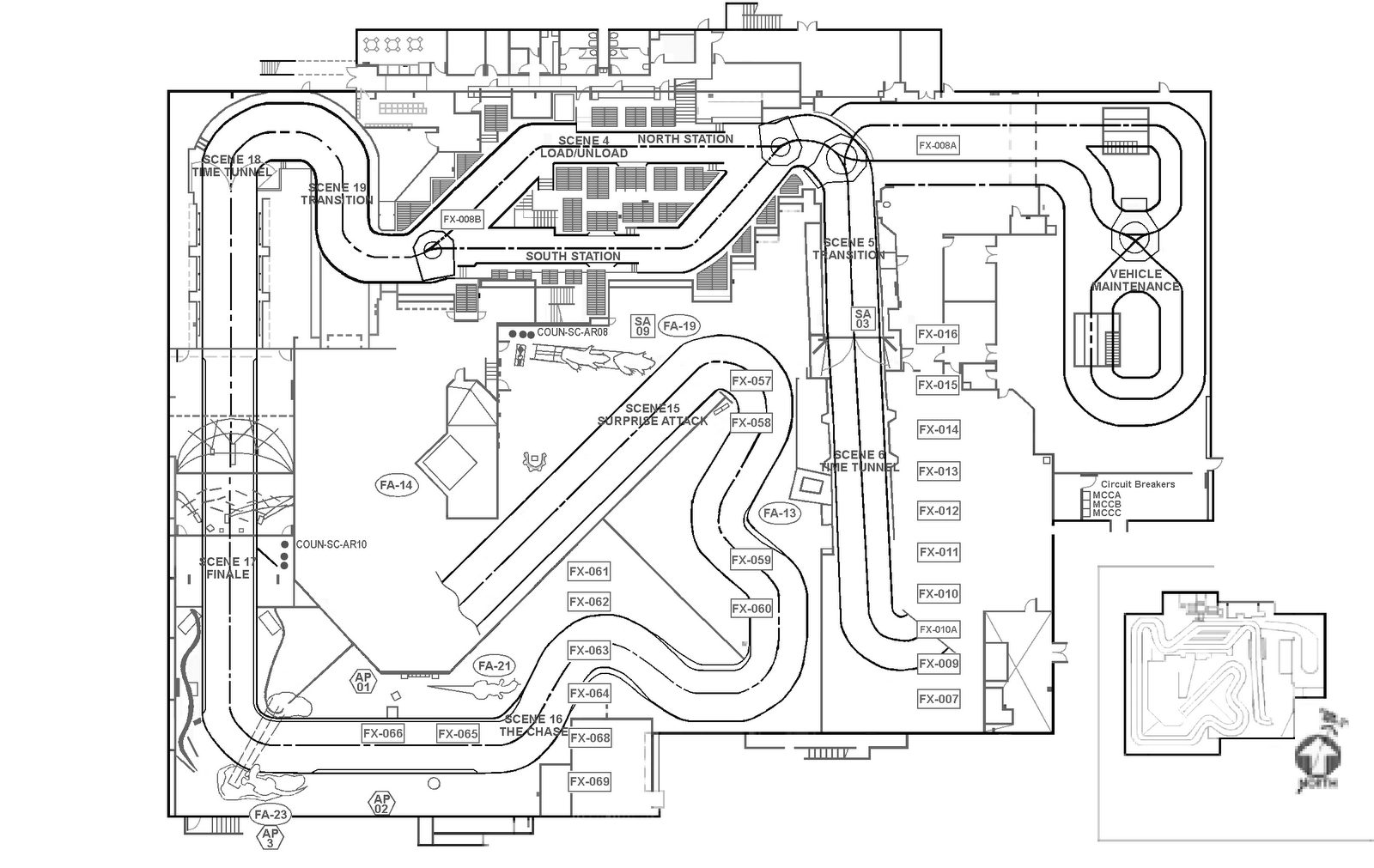
The Discovery Rive Boats opened in 1998 and closed in 1999 due to the number of disappointed guests who did not realize the nature of the attraction. Below is an overhead layout diagram of the original ride. Click on the image for a larger picture.
If you’re an avid fan of Roller Coaster Tycoon or No Limits coaster simulations then you may really enjoy this new book. Have you ever wondered what it takes to design and build a roller coaster? At last, there's a book that shows you. Coasters 101: An Engineering Guide to Roller Coaster Design examines the numerous diverse aspects of roller coaster engineering, including some of the mathematical formulas and engineering concepts used.
This technical guide is the most detailed roller coaster design book to date and will take you through the entire process, from concept to creation. A must read for every enthusiast and aspiring roller coaster engineer!
I'll be talking about roller coasters on an upcoming episode of the Omgea Tau podcast (science and engineering in your headphones).
A new take on the theme park ride online games is called Ride Sims which puts you in control of all your favorite theme park rides & attractions. Bascially, you are put in the control room of one of nine attractions and must learn to operate the attraction by dispatching the trains in a safe and efficient manner. If you want to work in the amusement park industry this game offers some nice insight into the workings of major thrill ride.
The other neat aspect of this game is all of the attractions are real rides and include and overhead layout diagram of each one. This is great for people like me who are always trying to figure out a ride's layout or blueprint.
Here's the layout for Hong Kong Disney's Space Mountain
...we have a new concept but you will not see it out in the open.
It is a thrill version of our Free Fly “family” coaster, capable of a truly unique ride sensation never before experienced and exclusive to S&S...
...we’ve patented the mechanical piece that creates the ride experience.
We vetted the idea with significant people in the industry last year at IAAPA and over the year.
...a new product, especially one of the caliber we are introducing, S&S is making a statement: beyond being creative...
...we have partnered with an engineering firm in Southern California that specializes in aerospace and government contracts, and have additional tools and engineering resources we don’t. This union has created a feasibility study and product analysis I doubt has ever been done before.
...decision to bring in the best talent, worldwide, to create, engineer and validate not only the ride, but also the effects the ride experience has on the human body.
...the ride concept, which has a “4th-dimension type ride experience” but at half the cost of a 4D coaster, is extreme and thrilling beyond previous experience...
What really got my attention from the above information was the fact they have already patented the concept. Knowing this, I scoured the internet to try and find this patent. Well, I didn't find any new patents related to S&S Worldwide or any of their engineers but this didn't exactly surprise me because it sounds like they want to keep this under wraps.
However, after an extensive search, I believe I found the patent and the type of ride system they could be talking about here. It doesn't have a name that I know of at this point so I am going to dub it "the gyro-coaster."
The seat assembly is capable of fully rotating about a first axis, second axis, and third axis independent of the track system. The rotation can be free or controlled. Each individual vehcile assembly could have a different degree of motion than the other vehicle assemblies.The launch tower concept looks pretty cool too!
Here's the evidence that leads me to believe this is the ride we are looking for.
The patent was filed in 2009. S&S discussed the idea at the IAPPA show in 2010, thus the timeline works out and makes sense.
The patent attorney's office is in Salt Lake City, Utah, not far from S&S headquarters.
The inventor resides in Southern California (and presumably works for the hired engineering firm). I couldn't find any other information on the inventor, which is odd.
When S&S Arrow filed the patentfor the 4d coaster they used James Sonntag as their patent attorney, the same person who shows up on this new patent.
Is this all just coincidence? I have no idea if it actually is but the evidence would lead me to believe we are looking at new ride concepts from S&S Worldwide. You can see why they would bring in another firm to do analysis- some pretty complicated dynamics there! If this is true, I am really excited by this design concept. The possibilities are endless; the human body being the major limiting factor. What are your thoughts?
Here's a few overhead pictures of the layout for Dinosaur at Disney's Animal Kingdom. I believe the layout is the exact same as the Indiana Jones ride at Disneyland.
I love looking at ride layouts or diagrams. If you've ever wondered what the overhead ride layout of the Amazing Adventures of Spiderman at Universal's Islands of Adventure looks like this is the best one I've seen. Attached is a diagram of what is probably the layout, at least it looks like it is pretty accurate from what I can remember. It's a very disorienting ride. Number 50 is the unload and load stations. How does Spiderman work? The ride basically uses a six axis Stewart platform mounted to a vehicle chassis with the added ability to rotate due to a ring and pinion gear system. Attached are a few drawings from the patent for this amazing amusement ride vehicle.
Last week I was trying to figure out how a Zamperla Demolition Derby ride worked. After a lot of research and digging through the interwebs I have finally found some answers. I actually haven't figured out how Zamperla's modern version works, but I have found a few patents for earlier versions of the ride. You see, the demolition derby is actually based on a ride called "the crazy daisy" (or crazy dazy) built by Philiadelphia Toboggan Coasters (PTC). There's also another variation called the Cuddle Up (or cuddle-up) which I think depends on the number of turntables involved. Anyways, here are a few of the patents with diagrams of the flat rides with intersecting ride paths:
Have you ever wondered what a work instruction manual for a roller coaster entails? First of all, what am I even talking about? Well, a roller coaster or amusement park ride manufacturer creates a manual of how to safely operate and inspect their thrill machine. This is basically a work instruction book given to the park and contains all of the preventive maintenance steps as well, safe operating procedures, and anything else needed to maintain the ride. Some of these handbooks even contain mechanical drawings and engineering calculations!
So what does one of these manuals look like? Well, it just so happens that I have been able to find one on the internet and will share it with you. You can download the pdf here. You might learn a thing or to about how a roller coaster works! Be sure to check out some of our other diagrams.