I've just released the new edition of my book, Coasters 101: An Engineer’s Guide to Roller Coaster Design. If you purchased the Kindle version previously you get free updates. If you purchased the paperback version, you can get the latest digital version for free now too! The latest edition (third) has pictures, diagrams, new content, a better layout, and other general improvements. My goal is to make this book simply the best, most complete, most detailed guide to designing roller coasters you can find. A few of the most recent reviews tend to agree:
“Very impressive! What a great resource to have..for anyone.” - John S.
“Thanks for writing a very good book. I could not put it down. Lot's of great information. I am a technology and engineering teacher and the information I found here is very helpful in trying to get students more excited about engineering.” Amazon reviewer
Rotation about the track spine
Some of the questions about roller coaster design you will have answered after reading include:
What software do roller coaster engineers use?
What college major is best to become a coaster designer?
How many engineers does it take to design a coaster?
How do roller coasters reach their highest point?
Why don’t coaster cars roll backwards down the lift hill?
Why do wheels on steel coasters come in pairs?
Why do we see so many clones of the exact same ride built at multiple parks?
How does a 4D coaster work?
How much does a roller coaster cost?
How much time does it take to design a roller coaster?
What is the difference between LIM and LSM propulsion?
What sort of background is necessary to get into the roller coaster engineering field?
How do you calculate the amount of power needed for the lift hill?
I've just released my latest book - Observation Wheels: Guide to the World's Largest Ferris Wheels. The race to build the largest observation wheel is on! Ferris wheels have been around for over one hundred years but have only just recently begun climbing to new heights. The classic Ferris wheel can be found towering over almost every amusement park and carnival midway. Today, these giant, high tech observation wheels are becoming status symbols for cities around the world. The race to build the biggest is heating up. Who invented the Ferris wheel? How do they work? Where are the most unique Ferris wheels found? Observation Wheels: Guide to the World’s Largest Ferris Wheels answers all of these questions and more, including details on more than 60 of the world's most unique giant wheels.
This is the "sort-of" sequel to Coasters 101: An Engineer's Guide to Roller Coaster Design (which will hopefully be getting updated this fall). I've compiled statistics on almost seventy of the world's biggest Ferris wheelsm including the most unique ones in the world. Did you know there are eccentric Ferris wheels that combine the classic Ferris wheel with a car that rolls on a track like a roller coaster? Learn about it and more in my new book.
Pick your amusement park, anywhere on the planet, and where are the longest, most aggravating lines? The roller coasters! A blazing fast thrill ride that just keeps pushing the envelope - to the daredevil delight of thousands. But as loopy as the creativity gets or the steeper the drop, or the faster the turns and the louder the screams- one thing they aren't, overall, is unsafe.
Find out how roller coasters are designed with the highest of safety standards by reading Coasters 101: An Engineer’s Guide to Roller Coaster Design by Nick Weisenberger. Warning: Side effects of reading may cause dizziness, nausea, or the sudden urge to visit a theme park.
The newly revised Second Edition includes interesting addedcontent like:
Today, we look back on another classic attraction of Disney World's Magic Kingdom which is no longer with us. The Skyway was removed from the Magic Kingdom in 1999 after a maintenance worker was killed from falling off a gondola while working on the ride. One unique aspect of this particular ride was the fact that it wasn’t laid out in a straight line like the majority of other similar sky ride type transportation rides. Magic Kingdom’s Skyway had more of a L-shape with a bend in the middle.
Overview and Layout
The Disney Skyway was an aerial tramway providing a scenic overview of the park and stretched from Tomorrowland to Fantasyland in the center of Walt Disney World’s Magic Kingdom. Guests boarded at either end for a one-way trip to the opposite station, traveling in gondolas (cabins) suspended from a moving cable. Each cabin could accommodate up to four adult guests. For guests boarding at the Tension Station in Tomorrowland, the cabins traveled along the moving cable across the Grand Prix Raceway, came down at the Transfer Station and made a 116 degree left-hand turn, then climbed and crossed Fantasyland ending their journey at the Drive Station. The Skyway ride system consisted of 50 cabins, which traveled on 3600 feet of steel wire rope.
How it worked
Like all Disney theme park attractions, the ride was closely monitored and controlled by a Ride Control System (RCS). Emergency Stops were provided at each station, and the RCS could also stop the ride based on certain fault conditions. The Skyway actually was designed with an auxiliary backup diesel motor. This was only used to cycle out the ride if the main drive motor became inoperable. The motor powered a hydraulic pump which provided hydraulic pressure to one of two motors: one located at the gear box to be used if the main drive motor was inoperative, and a second one located upstairs at the bullwheel to be used if the gearbox was inoperative. The second motor turned a ring gear mounted on the bullwheel to drive the wheel directly when the gear box was disconnected from the torque tube connecting it to the bull wheel.The main motor drive shaft had a double action brake actuated by weights which clamped the shaft after the motor had stopped to dampen out reactive force from the stop and hold the shaft stationary. When the motor was started, a relay energized a coil which lifted the brake thus releasing it. Electrical power was supplied into the Skyway attraction from Reedy Creek Energy Services and the transformers were located inside the west end of the It's a Small World ride building.
End of an Era
The station in Tomorrowland was destroyed in 2009. Even after the ride closed the Skyway station in Fantasyland stood for many years, but has recently been dismantled as part of the New Fantasyland expansion project (which saw the closure of Snow White's Scary Adventures).
Snow White's Scary Adventures was an attraction located in Fantasyland at Walt Disney World's Magic Kingdom in Orlando, Florida. The ride was recently closed forever (May 2012) as part of the New Fantasyland expansion and renovation project. Let's take a look back at this classic dark ride as it lives on in our hearts and memories.
Snow White’s Adventure was based on the Walt Disney film classic of 1937. The attraction brought to life the well known fairy tale of Snow White and her adventures with her little friends, the Seven Dwarfs, and the wicked Queen. Guests were transported via a six-passenger vehicle - themed like a mine car - on a three-minute ride along a 617 foot track. During the ride guests passed through scenes depicting the Castle Courtyard, Queen’s Chamber, Dungeon,Threatening Forest, Frightening Forest, Friendly Forest, Dwarfs' Cottage, Chase Begins, Dwarfs' Mine, the Cliff, Loves First Kiss, and finally They Lived Happily Everafter with Snow White and the Prince. The scenes used effects such as animated props, animated figures, projectors and lighting to create the correct illusions.
How it worked - Disney Magic Unveiled
The Snow White’s Adventure ride consisted of 17 six-seat vehicles. The vehicle consisted of a fiberglass body attached to a chassis. The vehicle rode along a steel track which contained a bus bar. The vehicle was connected to the bus bar through contacts located on the front bogie assembly. These contacts collect the electrical power from the bus bar and transfer it to the motor located on the rear bogie assembly.The mine car themed vehicles were electrically operated and traveled along a guide rail with a bus bar. Safety lap bars automatically engaged as the vehicles left the Load Area. The bus bar was supplied by the attraction main electrical feed at 240 VAC. There were two isolated conductors of the bus bar which are parallel and horizontal to the exterior of the track surface. A third isolated conductor was mounted on the opposite of the track and acted as the ground for the system. The bus bar ran the entire length of the ride track.
Audio-Animatronics(AA) figures
The Snow White ride featured a few Audio-Animatronincs figures. The Animated Figures are mechanical actors (person or animal) designed to perform an action or actions in a show scene. A steel skeletal framework, jointed as required, makes up the figure. The figure is covered with a body form and costume for the character that it portrays. The activity of the figure is controlled by electrical signals. These signals are sent from the show control system (SCS). A combination of components are used to control the movement of the figure. These components include and are not limited to pneumatic valves, mechanical feedback actuators, solenoid valves and first stage valves. Each figure will contain a combination of these components. The actuators and electric motors are contained within the AA figure or the base frame under the figure.
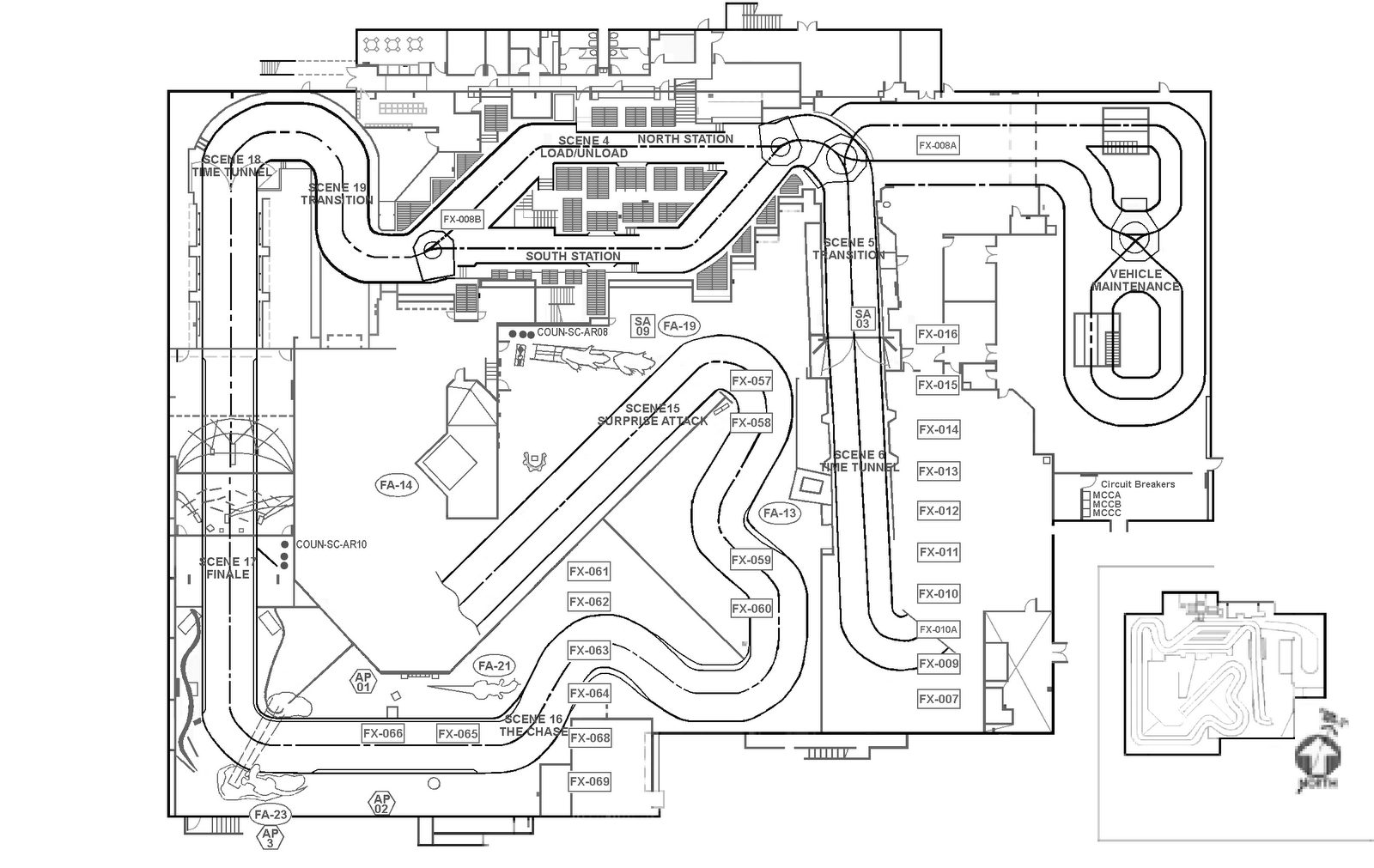
Snow White Ride Blueprint and Overhead Layout
Embedded below is the best official looking layout I could find of the Snow White attraction on the internet.
Galveston Pleasure Pier is one of the few spots in the world that has this many rides over the water! Known as “Coney Island of the South”, the pier juts 1130 feet into the Gulf of Mexico and is 120 feet-wide. The Galveston amusement pier now boasts one roller coaster and 15 other thrilling rides. The original Pleasure Pier stood from 1943 until 1961 when it was destroyed by a hurricane. A soft opening event was held on May 25th, 2012. The total cost of the project is estimated at sixty million dollars but will bring new jobs back to the Galveston area. Three million guests are expected to visit the pier in its first year of operation. The park is located at Galveston Pier 21. There will also be a retail center called Shops at Pleasure Pier on the north side of Seawall Boulevard and a Bubba Gump Shrimp restaurant will be built to go along with the rides and games.
The main attraction is the brand new, 100 foot tall steel roller coaster dubbed “Iron Shark.” It’s a Gerstlauer Eurofighter style ride compacted into a tiny footprint. The Pleasure Pier's Iron Shark roller coaster will attack when least expected with its 100‐foot vertical lift and beyond‐vertical drop. Tracking at 52 miles per hour, the vehicles will glide the 1,246‐foot coaster track. Check out the video embedded below to see the ride in action:
The pier will feature a number of traditional rides, including a 36-foot double-decker carousel and a 100-foot tall Ferris Wheel. Another highlight of the Galveston boardwalk is the Texas Star Flyer, a 230 foot tall swing ride which swing your dangling feet out over the ocean. Please note, this ride is not yet open as it is still under construction. Rides closed are the Galaxy Wheel, Texas Star Flyer and Revolution.
The Pleasure Pier Galveston theme park is wholly owned by Landry's, Inc.
I just posted an interview with Andreas Wild Stengel Engineering (an interview feature started back in September) to Coaster101. What really intrigued me was his response to this question: "At what stage in the creation of an amusement park attraction does Stengel Engineering become involved?"
And his response " ...sometimes the layout shows dramatically false guesses (in terms of accelerations, clearances, etc.) and we have to redesign the layout entirely. Sometimes this is too late to redo things completely and we have to find a compromise which works for all parties."
Wow! Could he be referring to Intamin projects such as Maverick where they had to remove an entire inversion element? Or Millennium Force where they screwed up the clearance envelope by placing some of the roller coaster's supports too close to the track (pictured below)? I think so. Do you?
Attention theme park fans! What Would Walt Do? is a new eBook about the team members, construction workers, and engineers left with the task of building the Walt Disney World resort after Walt Disney's death in December of 1966. The book was written by project manage D. M. Miller and the question "what would Walt do" came up every time a decision had to be made. In the end it was determined that Walt would want to do the right thing. He would've selected the highest quality option available regardless of the cost. Download this fantastic eBook as a PDF file right to your computer today. A must read for all fans of Walt Disney and the Walt Disney World resort.
I recently was interviewed for the Omega Tau podcast (science and engineering in your headphones). You can listen to me ramble about roller coasters here. I'd like to extend my thanks to Markus for inviting me to appear on his show to talk about different aspects of roller coasters.
The Discovery River Boats was an attraction at Disney's Animal Kingdom. They were diesel powered boats which made a circuit around the Tree of Life. One scene along the route was called "the Dragon's Cave" and was located on the riverbank of Discovery River adjacent to the Beastly Kingdom Bridge. When riverbank sensors detected an oncomming Discovery River Boat, an audio roar and fire stream simulate the approach of a fire breathing dragon just inside riverbank cave structure.
The Discovery Rive Boats opened in 1998 and closed in 1999 due to the number of disappointed guests who did not realize the nature of the attraction. Below is an overhead layout diagram of the original ride. Click on the image for a larger picture.
If you’re an avid fan of Roller Coaster Tycoon or No Limits coaster simulations then you may really enjoy this new book. Have you ever wondered what it takes to design and build a roller coaster? At last, there's a book that shows you. Coasters 101: An Engineering Guide to Roller Coaster Design examines the numerous diverse aspects of roller coaster engineering, including some of the mathematical formulas and engineering concepts used.
This technical guide is the most detailed roller coaster design book to date and will take you through the entire process, from concept to creation. A must read for every enthusiast and aspiring roller coaster engineer!
I'll be talking about roller coasters on an upcoming episode of the Omgea Tau podcast (science and engineering in your headphones).
A new take on the theme park ride online games is called Ride Sims which puts you in control of all your favorite theme park rides & attractions. Bascially, you are put in the control room of one of nine attractions and must learn to operate the attraction by dispatching the trains in a safe and efficient manner. If you want to work in the amusement park industry this game offers some nice insight into the workings of major thrill ride.
The other neat aspect of this game is all of the attractions are real rides and include and overhead layout diagram of each one. This is great for people like me who are always trying to figure out a ride's layout or blueprint.
Here's the layout for Hong Kong Disney's Space Mountain
Here's a few overhead pictures of the layout for Dinosaur at Disney's Animal Kingdom. I believe the layout is the exact same as the Indiana Jones ride at Disneyland.
I love looking at ride layouts or diagrams. If you've ever wondered what the overhead ride layout of the Amazing Adventures of Spiderman at Universal's Islands of Adventure looks like this is the best one I've seen. Attached is a diagram of what is probably the layout, at least it looks like it is pretty accurate from what I can remember. It's a very disorienting ride. Number 50 is the unload and load stations. How does Spiderman work? The ride basically uses a six axis Stewart platform mounted to a vehicle chassis with the added ability to rotate due to a ring and pinion gear system. Attached are a few drawings from the patent for this amazing amusement ride vehicle.
Can anybody here explain how a Zamperla Demolition Derby ride works? From my understanding there are two turn tables which spin in opposite directions and the cars, which are free to spin in their own independent circles, are transferred from one turn table to another. It's the "hand off" between turn tables that specifically interests me. How do they do it? This ride system is used at the Disney studios park in Paris as Cars Race Rally. A new twist on the design is being built at California Adventure as Mater's Junkyard.
Have you ever wondered what a work instruction manual for a roller coaster entails? First of all, what am I even talking about? Well, a roller coaster or amusement park ride manufacturer creates a manual of how to safely operate and inspect their thrill machine. This is basically a work instruction book given to the park and contains all of the preventive maintenance steps as well, safe operating procedures, and anything else needed to maintain the ride. Some of these handbooks even contain mechanical drawings and engineering calculations!
So what does one of these manuals look like? Well, it just so happens that I have been able to find one on the internet and will share it with you. You can download the pdf here. You might learn a thing or to about how a roller coaster works! Be sure to check out some of our other diagrams.